


-
Written by Dr. Shin Jeong Won, Tong-In Clinic
-
Edited by Sia

Hello! I'm Shin Jeong Won, doctor at Tong-in Korean Medicine Clinic.😊
Korea's hot summer has passed (well, maybe still passing😂), and finally, the cool autumn has arrived. But there’s an unwelcome guest every seasonal change — allergies! 🤧
Why Your Allergies Get Worse When the Seasons Change
📌 Airborne Allergens Rise & Immune System Overreacts 🍂🛡️
During seasonal transitions, winds become stronger and humidity decreases.
This makes allergens (substances that cause allergic reactions) like dust mites, mold spores, pollen, and fine dust float more easily in the air.
When these allergens come into contact with the inside of your nose, our body's immune cells mistakenly identify them as 'dangerous invaders' and trigger an overreaction.
The problem here is that in addition to allergy triggers, 'your personal hypersensitivity also plays a role.
Even pollen or dust mites that are harmless to most people can cause excessive immune system activation in individuals with an allergic constitution, generating antibodies and releasing inflammatory substances such as histamine.
As a result, you suffer from symptoms like sneezing, a clear runny nose, itchy eyes and nose, and nasal congestion.
📌 Rapid Temperature Changes → Sensitive Nasal Membranes and Lower Immunity🌡️

During seasonal transitions, morning and evening temperature differences can exceed 10 degrees. Such rapidly changing temperatures stimulate blood vessels in the inside of your nose, disrupting the balance of the autonomic nervous system.
Especially allergy patients who have originally sensitive nasal mucous membranes react more sensitively to temperature changes, which can worsen their symptoms.
Also, as we transition from summer to autumn, daylight hours decrease. Many people change their sleep and lifestyle patterns during this time. These changes can lead to a decrease in immunity, which can make allergic reactions more severe.
📌 Indoor Living & Insufficient Ventilation 🏠
When the weather becomes chilly, we spend more time indoors with windows closed. During this time, we're exposed to more allergens, such as indoor dust, mites, and mold.
Additionally, when heating begins, the indoor air becomes dry, weakening the nasal passages and making them more susceptible to allergens.
—
Seasonal allergic rhinitis is greatly influenced by the increase of airborne allergens during 'seasonal transitions.'
In addition, it's a complex disease resulting from the combined reaction of your allergic constitution and hypersensitivity, which responds sensitively to these factors, along with abnormal immune system responses.
So how do we manage it?
To treat seasonal allergies, both changing the environment and checking your body's immune system are necessary.
📌 Reducing Allergy Triggers
Since 'increased allergens' are the problem, we can solve it by addressing that!
-
Frequent ventilation and cleaning: Especially wash bedding frequently, as dust accumulates easily in these areas.
-
Maintain a suitable indoor air temperature and humidity level
-
Nasal irrigation to protect and keep the nasal mucous membranes moist: However, using any solution indiscriminately can risk complications and infections. It's essential to gently rinse with a saline solution specifically designed for nasal irrigation, available at pharmacies, or with a saltwater solution made by boiling and then cooling water with added salt.
📌 How to Manage Allergies and Sensitivities
There are areas where Korean medicine excels, and there are areas where modern medicine clearly excels. I recommend the approach that offers the better treatment, depending on the situation.
And one area where Korean medicine provides much better treatment is 'allergic rhinitis'!

Antihistamines commonly used for allergy treatment help with temporary symptom relief. Still, they can't address my 'allergic tendency (hypersensitivity)' and 'immune system dysfunction.' While medications have been upgraded through several generations, antihistamines still have considerable side effects like drowsiness, dry mouth, and constipation.
However, Korean medicine treats rhinitis not just by easing symptoms, but also by gently reducing your body's overreaction to allergens. (We often say it “improves immunity,” but it’s more accurate to say it lowers your sensitivity to allergens.)

According to a 2021 paper on 'Oral application of Chinese herbal medicine for allergic rhinitis,' herbal medicine treatment showed the following advantages compared to antihistamines:
-
Relief of overall nasal symptom scores and individual symptom scores (runny nose, nasal congestion, sneezing, and nasal itching)
-
Quality of life improvement
-
Reduced recurrence rate
-
Side effects are generally mild and temporary
Effective Korean Herbal Medicine and Acupuncture for Rhinitis Treatment
Korean medicine clinics prescribe herbal remedies that reduce inflammation and help restore your nasal lining, based on the patient's diagnosis and their usual constitution or current nasal condition.
By reducing swelling in the nasal lining, this treatment can ease congestion and inflammation, helping to reduce sneezing and a runny nose.
Additionally, acupuncture treatment around the nasal area is effective in regulating blood flow to the nasal mucous membranes and improving airflow. (He M, Qin W, Qin Z, Zhao C. Acupuncture for allergic rhinitis: a systematic review and meta-analysis. Eur J Med Res. 2022 Apr 25;27(1):58.)

📌 What Korean Herbal Medicines are Prescribed?
Korean herbal medicines are prescribed in a custom-tailored manner to suit patients' constitutions and symptoms. Here are some representative examples:
-
Socheongryong-tang(소청룡탕): Effective for individuals with a severe, clear runny nose and sneezing. Regulates water metabolism to reduce a runny nose and cough.
-
Hyeonggae-yeongyo-tang(형개연교탕): Good for those who feel facial heat with nasal congestion and frequent throat swelling.
-
Bojung-ikgi-tang(보중익기탕): Helps those who feel easily tired and lack energy with recurring rhinitis. Supplements stamina, boosts immunity, and regulates allergic reactivity to prevent rhinitis recurrence.
-
Cheongin-yukhoehwan(청인유쾌환): A pill form that moisturizes the throat and nasal mucous membranes with anti-inflammatory action, helping reduce bronchial hypersensitivity. It can be taken consistently for preventive and management purposes for rhinitis.
📌 Korean Medicine's Rhinitis Immune Treatment
Additionally, herbal medicine for allergic rhinitis goes beyond simply reducing inflammation to help restore immune system balance, making it effective for chronic rhinitis.😉 While this mechanism is explained in various ways, I would like to introduce a representative recent research paper.

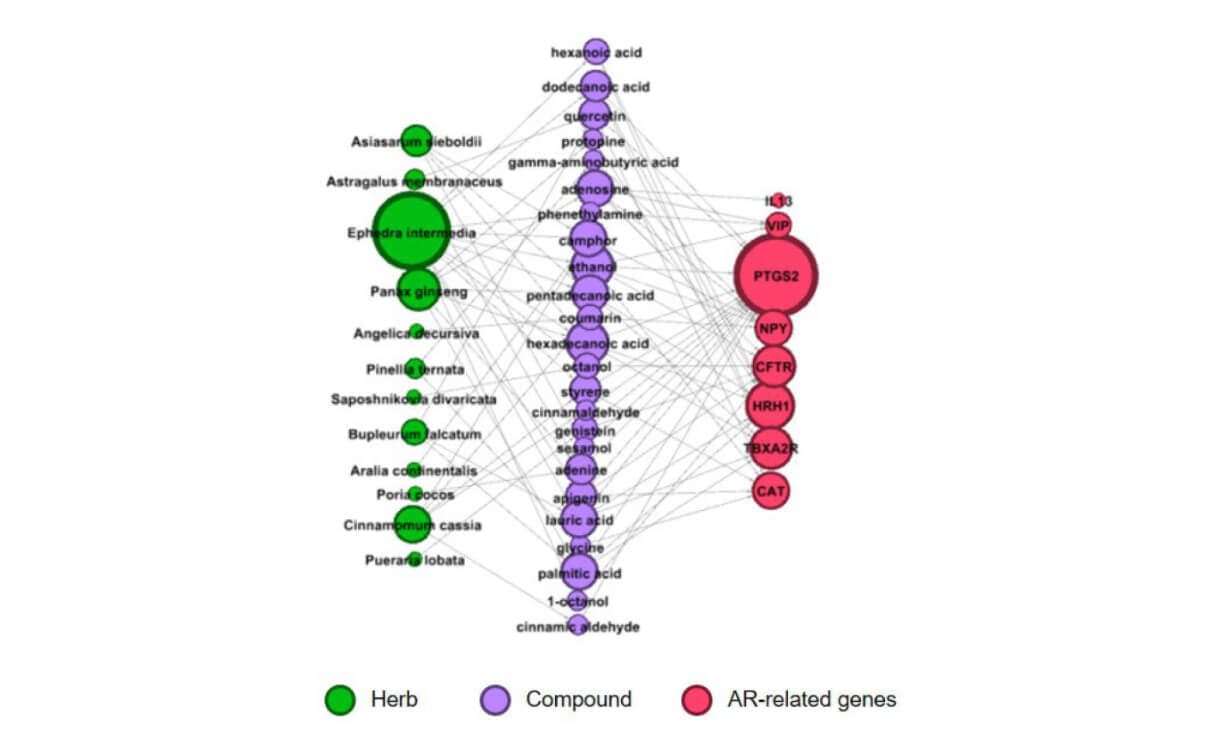
This study analyzed 14 Korean medicinal herbs commonly used for treating allergic rhinitis to explore their pharmacological mechanisms.
Results showed these herbs regulate multiple pathways targeting various genes related to inflammation and allergic reactions.
Unlike health supplements composed of single ingredients, herbal medicines composed of multiple ingredients can more effectively treat allergic rhinitis with fewer side effects, as they target various pathways involved in allergies, as shown in the diagram below.
📌 Allergic Rhinitis Treatment Costs and Duration

Since last year, 'allergic rhinitis' has been included in the pilot health insurance program for decoction prescriptions (Korean herbal medicine), allowing patients with health insurance to receive herbal medicine twice a year for under 100,000 won (approximately 50,000-80,000 won, depending on the type of medicine).
Treatment duration varies based on the treatment response, but you can expect it to last at least 1-6 months.
When I was young and caught colds, I always prayed, 'Please let it be a throat cold, not a nasal cold.' 😖 While throat pain was bearable, nasal congestion made breathing difficult, causing dizziness, headaches, and decreased concentration, which significantly lowered the quality of life and made it challenging.
Recalling this experience, I always empathize with and feel sorry for patients who visit with rhinitis, wondering how much they must be suffering.
How about overcoming allergic rhinitis this autumn with Korean medicine? 😉🤚
Wishing you a healthy seasonal transition! Always grateful for your support. ♥️


